birmingham

Embracing Autumn...

Embracing Autumn: Adjusting Mind, Body, and Spirit to Seasonal Change

As the air turns crisp and the days grow shorter, autumn invites us to slow down and align ourselves with nature’s rhythm.

Seasonal living means tuning into these subtle shifts and adjusting our lifestyles to support balance in body, mind, and spirit.

Autumn is a time of transition—of letting go, grounding, and preparing for the stillness of winter.

The cooler temperatures and shorter days can impact our energy levels and immunity.

This is the season to focus on warmth and nourishment.

Layer your clothing, keep your home cosy, and prioritize rest where possible.

Gentle but consistent movement, like walking outdoors or practicing Yoga, helps keep circulation strong and prevents stiffness as the body adapts to the chill.

Autumn often stirs emotions of change and reflection. Just as trees shed their leaves, we can release what no longer serves us.

Journaling, mindfulness practices, meditation or creative outlets can help process emotions and maintain mental clarity.

It’s also common to feel a dip in mood as daylight lessens—creating intentional moments of joy, connecting with loved ones, and seeking natural light can all be uplifting practices.
Autumn can be deeply symbolic: a reminder of cycles, impermanence, and the beauty of letting go.

Spiritually, it calls for grounding rituals. Yoga, daily meditation, gratitude practices, or spending quiet time in nature can foster a sense of peace and alignment with the season’s energy.

Ways to Stay Well in Autumn

  • Maintain a regular sleep routine to sync with earlier sunsets.

  • Hydrate and moisturise to counteract dry air.

  • Take walks in nature to absorb the vibrant colors and fresh air.

  • Strengthen immunity with herbal teas, vitamin-rich foods, and warm broths.

Yoga and Meditation for Autumn

Autumn aligns with grounding and balancing practices in Yoga.

SLOW FLOW and mindful YIN (STRETCH) practices are lovely for Autumn, as we slow down and energy turns inwards.

In contrast, balance with heat building practices such as FLOW and ENERGISE. Plus, twice a week we have WARM YOGA in the studio!

Meditation in Autumn can centre around gratitude, mindfulness, and visualization—imagining releasing old energies like falling leaves, making space for renewal, and new beginnings.

According to Traditional Chinese Medicine (TCM) and Five Element Theory, Autumn is connected to the lungs and large intestine. Deep breathing practices and supporting the respiratory system are important, and allowing ourselves to emotionally and mentally release what no longer serves us will feel beneficial.

Foods for Autumn

Autumn calls for hearty, warming foods that nourish deeply. Root vegetables, squashes, pumpkins, apples, pears, and warming spices like cinnamon and ginger align beautifully with the season.

Soups, stews, and baked dishes provide comfort and grounding energy.

Herbal teas such as chai, ginger, or rooibos support digestion and immunity.

Below we have linked a few Autumn recipes for you to try out and enjoy!

Butternut squash soup.

Vegetarian lentil cottage pie.

Baked apples.

Living seasonally is an act of harmony with nature, and can help us to maintain and improve physical, emotional, and spiritual wellbeing.

In the Western world we are often very disconnected from nature, and in essence ourselves.

Yoga Borne offers special seasonal and lunar inspired workshops and experiences for you to enjoy and rekindle this connection.

We have some wonderful offerings coming up in October.

Just click the link to find out more info and book!

Movement is Medicine / Friday 3rd / 7:30pm

Women Gather: Hunters Moon Edition / Tuesday 7th / 8pm

Reiki Healing Experience / Sun 19th / 1pm

Reiki Healing Experience / Sun 19th / 2:30pm

Crystal Bowl Sound Healing: Autumn / Sun 19th / 6pm

Slowdown Sunday: Autumn / Sun 26th / 6pm

Yoga Nidra (in studio) / Sun 26th / 7:30pm

Plus, the start of November brings a special workshop which has been a staple for the past few years, Samhain ( Halloween). This will be a wonderful afternoon of ritual and rest, with an optional creative activity. Find out more by clicking here.

Wishing you an abundant and blessed Autumn ahead!

More about... Sacred Seasons!

We are delighted to be offering a series of individual seasonal workshops this year, led by Studio Owner Karine - “Sacred Seasons.”

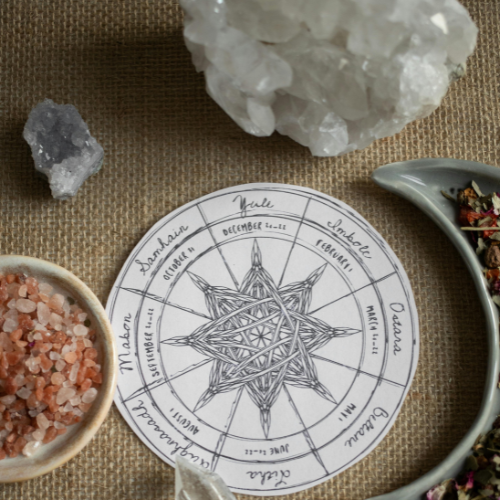
These will follow the Wheel of the Year, and the eight Sabbats (celebrations / festivals) - more about this below.

Join for individual workshops, or purchase the Sacred Seasons Course, where you will save £40 (1 workshop free), and plenty of support in creating a yearly Sacred Seasons journal / grimoire / book of shadows!

The first of 8 workshops honours Imbolc, is on Saturday 8th February and there are just 2 in studio space remaining.

Click here to find out more information, and grab one of the last spots!

If there is enough interest, this workshop will also run again at the end of Feb. Click here for booking.

Our Studio Owners are passionate about seasonal living, and as well as our workshops reflecting this, our schedule is also tweaked seasonally to reflect the changing seasons.

Spring will see us add some new classes to the schedule as the natural world, and we, start to reawaken.

Now, more about Sacred Seasons!

What is the Wheel of the Year?

The Wheel of the Year represents the cyclical nature of the seasons and their associated spiritual significance. It consists of eight festivals/ celebrations or sabbats, which mark the changes in seasons and /or solar events. These festivals celebrate the Earth’s natural cycles and are rooted in ancient European pagan traditions.

What are the Sabbats?

Solar Festivals (based on solstices and equinoxes):

  • Yule (Winter Solstice)

  • Ostara (Spring Equinox)

  • Litha (Summer Solstice)

  • Mabon (Autumn Equinox)

Fire Festivals (cross-quarter days, roughly midway between the solstices and equinoxes):

  • Imbolc (beginning of spring)

  • Beltane (start of summer)

  • Lughnasadh or Lammas (first harvest)

  • Samhain (end of harvest, beginning of winter)

Where Does the Wheel of the Year Come From?

The Wheel of the Year draws from pre-Christian European traditions, particularly Celtic and Germanic festivals, as well as Norse mythology, and popularized in modern times by the Wiccan movement in the mid-20th century. The Wheel of the Year could be seen as a spiritual framework that honours the cycles of nature.

Over the past year it has become even more popular, which is wonderful to see, if those who teach about it are also honouring it as a part of their lifestyle.

As with everything, it is important to do your own research, take what resonates with you, and be discerning in regard to teachers and guides.

Who Celebrates the Sabbats?

The Sabbats are celebrated in modern paganism, particularly Wiccans and Druids. However, people from different spiritual backgrounds, including those interested in nature-based spirituality, often observe these festivals as well. You do not have to have any particular belief system to learn more about seasonal and cyclical living.

How Can We Celebrate Each Sabbat?

  • Yule (Winter Solstice)

Light candles to honor the return of the sun.

Decorate with evergreens, holly, and mistletoe.

Exchange gifts or feast with family.

  • Imbolc

Light candles or fires to honor the growing light.

Cleanse and bless your home for the coming spring.

Celebrate creativity or honour Goddess Brigid.

  • Ostara (Spring Equinox)

Decorate eggs as symbols of fertility and renewal.

Plant seeds to honour new growth.

Celebrate balance, as day and night are equal.

  • Beltane

Dance around a Maypole to honor fertility and abundance.

Light bonfires to celebrate life and passion.

Decorate with flowers and greenery.

  • Litha (Summer Solstice)

Celebrate the longest day of the year with outdoor gatherings.

Light candles or a fire to honour the sun's power.

Create flower crowns or sun-inspired crafts.

  • Lughnasadh (Lammas)

Bake bread or other foods from the first harvest.

Host a feast to celebrate abundance.

Offer gratitude for the Earth’s bounty.

  • Mabon (Autumn Equinox)

Celebrate balance as day and night are equal.

Decorate with autumn colors and seasonal produce.

Reflect on gratitude and give thanks for the harvest.

  • Samhain

Honour ancestors and loved ones who have passed.

Light candles or carve pumpkins to guide spirits.

Reflect on endings and prepare for the winter ahead.

Hopefully this gave you some useful information about the Wheel of the Year and seasonal living.

Of course, each sabbat can be personalized based on individual traditions, creativity, and connection to nature. Enjoy!

Workshop Dates

Interested in learning more, combined with Yoga and Holistic wellbeing?

Join us for a Sacred Seasons Workshop or the Seasonal Living Course.

The workshops can also be joined online, but the creative activities will require you to purchase your own equipment.

Imbolc 8th and 22nd February

Ostara 22nd March

Beltane 3rd May

Litha 28th June

Lughnasadh 2nd August

Mabon 20th September

Samhain 1st November

Yule 20th December

Sacred Seasons: Seasonal Living Course details here.

More about... Lunar New Year!

What is Lunar New Year?

Lunar New Year marks the beginning of a new year based on the lunisolar calendar, which is tied to the cycles of the moon.

It is one of the most important holidays in many East and Southeast Asian cultures, symbolizing renewal, family reunion, and the ushering in of good luck and fortune.


Is it the same as Chinese New Year?

Lunar New Year and Chinese New Year overlap but aren't exactly the same.

Chinese New Year is one version of the Lunar New Year and is the most widely recognized.

Other cultures, like Vietnamese and Korean, celebrate Lunar New Year with their own traditions and customs.

When is Lunar New Year, and how long does it last?

Lunar New Year usually falls between January 21 and February 20, depending on the lunar calendar. In 2025, it begins on Wednesday January 29.
The celebration traditionally lasts 15 days in Chinese culture, ending with the Lantern Festival.

How do people celebrate it?

· Family reunions: Families gather for big meals,

· Cleaning and decorating: Homes are cleaned to sweep away bad luck and decorated with red items (for good luck).

· Food: Traditional foods include dumplings, rice cakes, noodles, and spring rolls. Each has symbolic meaning, like prosperity and long life.

· Red envelopes: Gifts of money in red envelopes are given for good fortune.

· Lion/dragon dances and firecrackers: These are used to ward off evil spirits.

· Visiting relatives and paying respects to ancestors.

Do you have to be a certain religion or culture to celebrate?

No, anyone can celebrate Lunar New Year!

While the traditions are rooted in specific cultures and histories, the spirit of renewal, family, and welcoming good fortune is universal.


What does the moon have to do with Lunar New Year?

The timing of Lunar New Year is based on the lunar calendar, which follows the cycles of the moon.

The holiday begins on the new moon and lasts until the full moon 15 days later.

The moon’s phases are central to the lunisolar calendar used to calculate the date.


Yoga for Lunar New Year

You might like to explore shapes and sequences that incorporate Moon Salutation (Chandra Namaskar).

Grounding shapes and sequences including Tadasana, Warriors, and Tree Pose.

New moons offer us time to rest and reflect - why not explore some meditation, mindfulness or even practice a Yoga Nidra.

Lunar New Year & New Moon Meditation

Head over to Yoga Borne YouTube, or simply click the here to listen to our mindful meditation in honour of Lunar New Year and the first new moon of 2025.

Wishing you a year ahead of health, happiness and abundance!